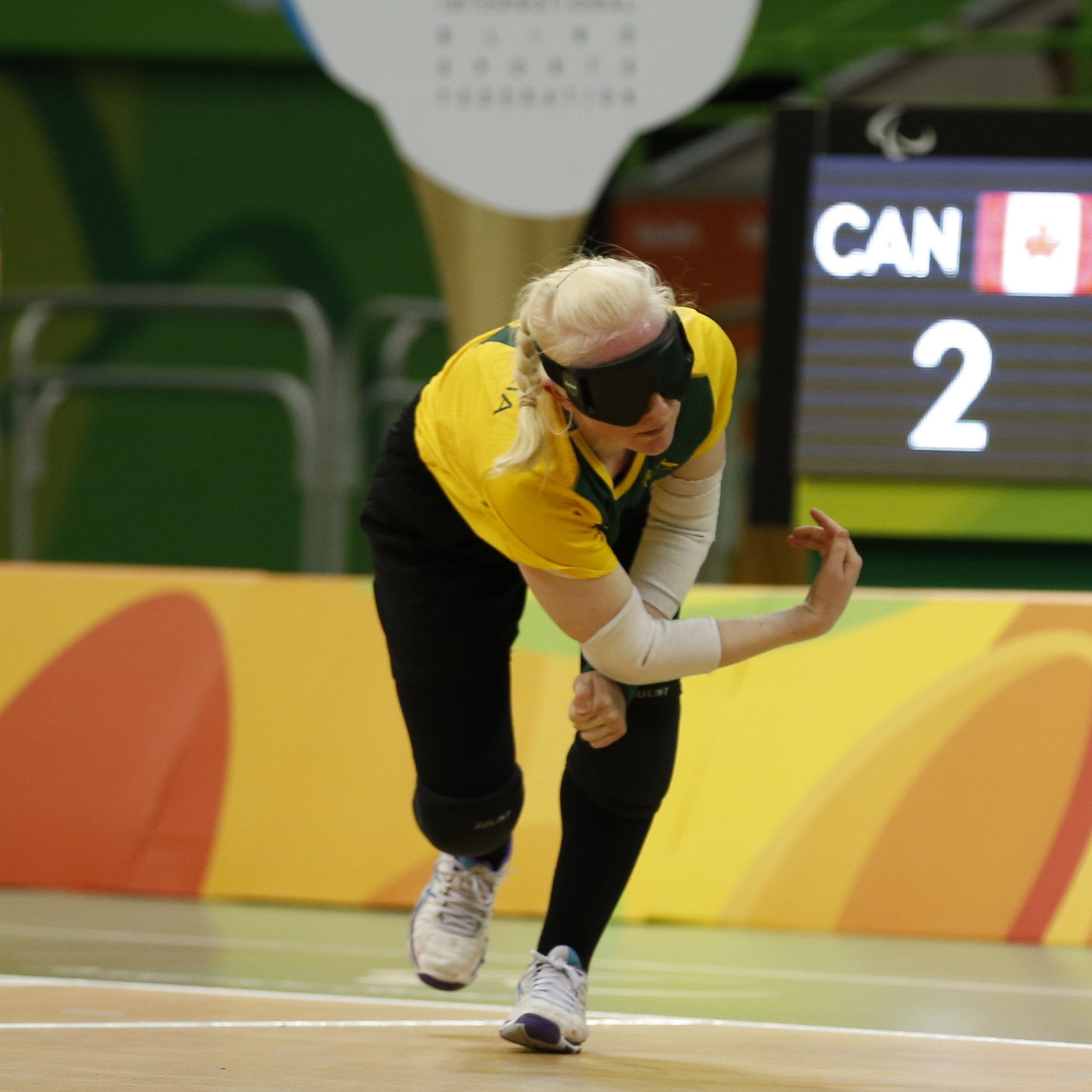
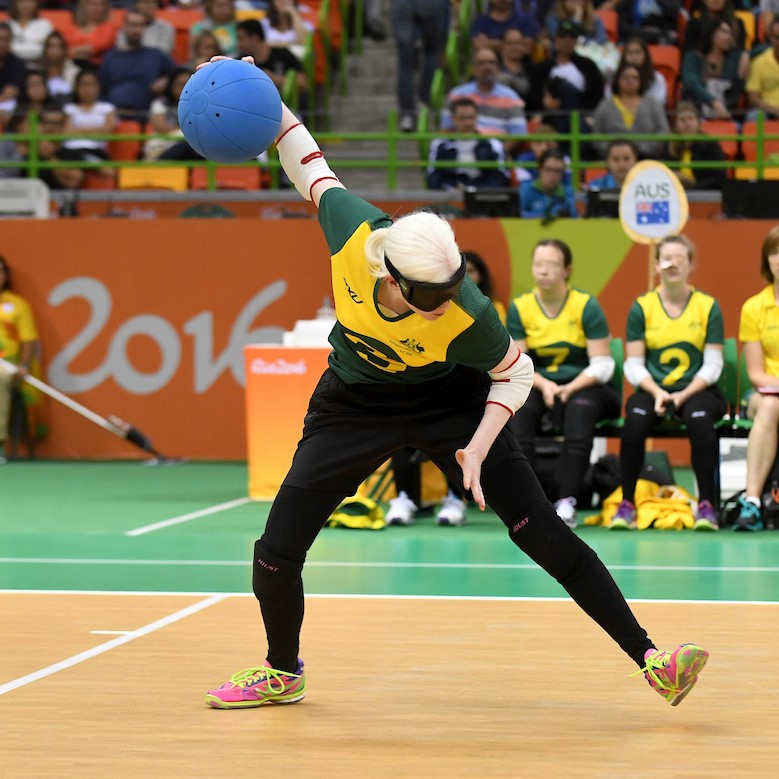
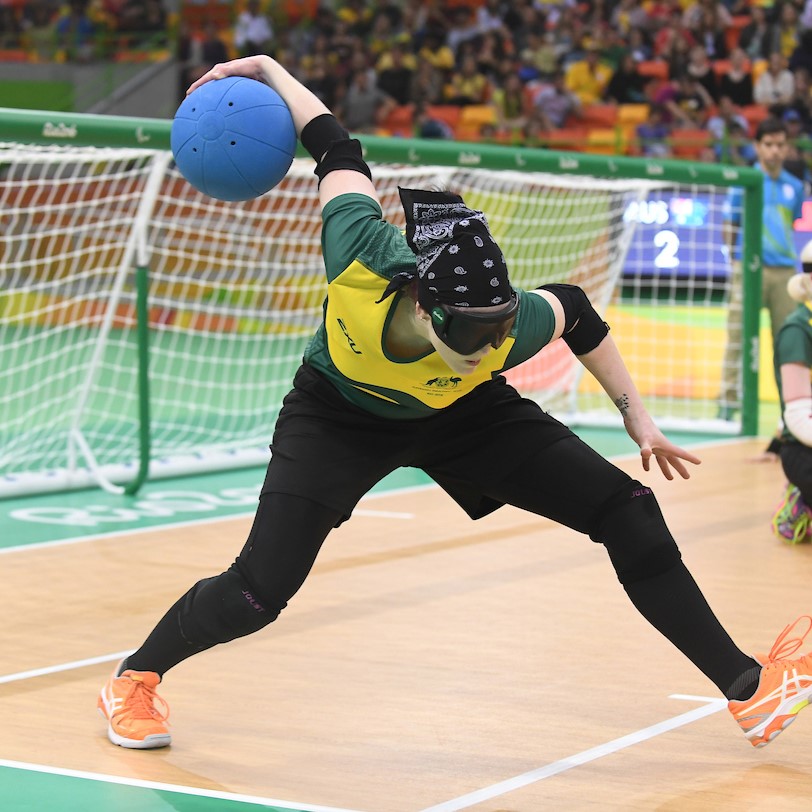
Men’s and women’s team events are contested at the Paralympic Games.

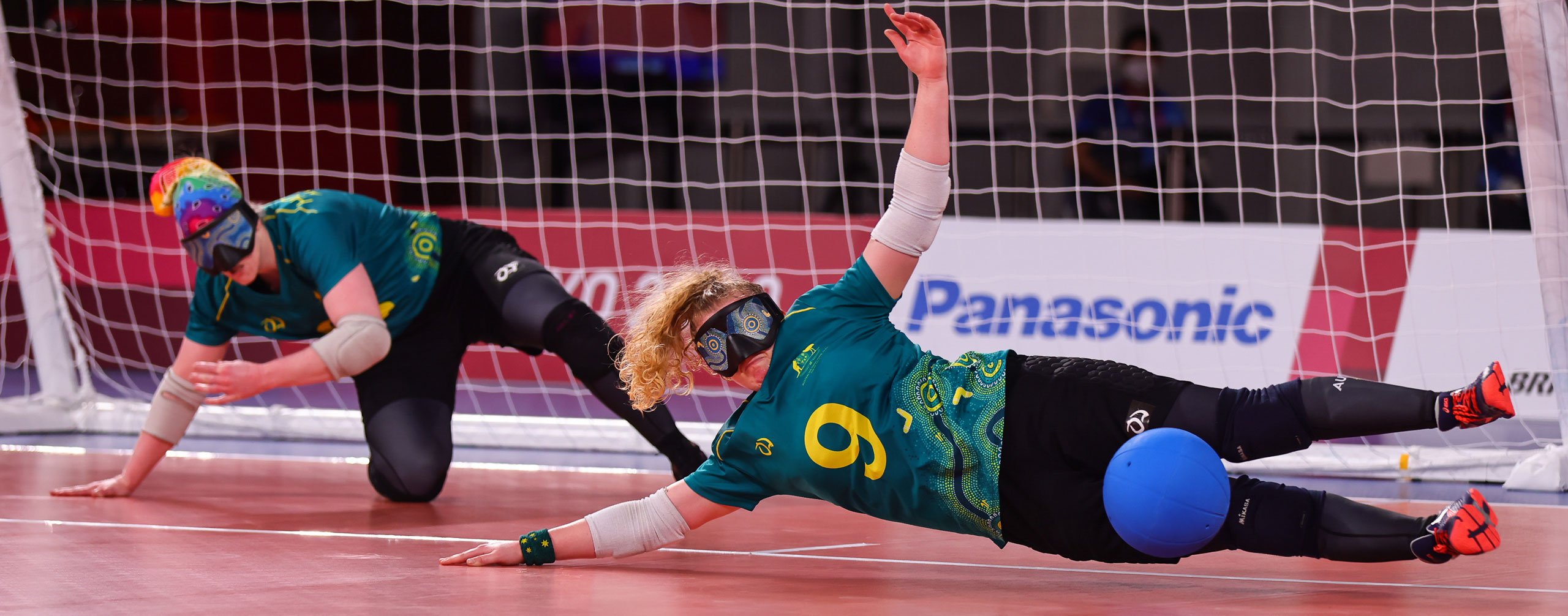

Men’s and women’s team events are contested at the Paralympic Games.
Goalball is open to athletes with a vision impairment. Athletes are required to submit medical reports and meet the minimum impairment criteria in order to compete. Eligibility is determined by trained Classifiers.
For more information on Eligible Impairments and Classification please see the Goalball Information Sheet (PDF) – updated May 2024.
Court
The court used for goalball is an 18m x 9m rectangle. Starting from the final lines, where the goalposts are placed, a 9m x 3m team area and a 9m x 3m landing area for each team is marked. The remaining 9m x 6m area, between the two landing areas, is called the neutral area, which is divided into two parts by the centre line. With the exception of the final lines, all court markings are tactile to help players orientate themselves on court.
Goals
Regulation goals measure 9m (equal to the length of the court) x 1.3m.
Ball
The ball used for goalball competition is made of rubber, weighs 1.25kg and has a circumference of approximately 76cm. It has eight holes and there are noise bells inside. The ball must meet the specifications of the IBSA Sport Technical Committee.
Clothing
Teams must wear matching jerseys, pants and socks with a number clearly visible on the front and back of each player.
Blackout Masks
All competitors must wear blackout masks at all times on court. At all major competitions all players have their eyes covered by gauze patches under the supervision of the IBSA Goalball Technical Delegate. Penalties are given if a player touches the blackout mask during play. This ensures that the level of vision of all players is equal.
Goalball made its Paralympic debut in Toronto, Canada in 1976 and the women’s event was added at the 1984 Paralympic Games in New York, USA.
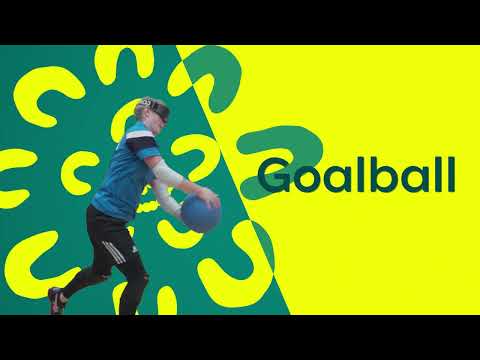
Goalball is a team sport played indoors by athletes with vision impairment. The object of the game is to roll the ball into the opponent’s goal while the opposing players try to block the ball with their bodies. Bells inside the ball help orientate the players by indicating the direction of the oncoming ball.
For more information on goalball Eligibility and How to Get Involved please see the Goalball Information Sheet (PDF) – updated May 2024.
| Games | Total | |||
|---|---|---|---|---|
| ARNHEM 1980 | 0 | 0 | 0 | 0 |
| NEW YORK & STOKE MANDEVILLE 1984 | 0 | 0 | 0 | 0 |
| SEOUL 1988 | 0 | 0 | 0 | 0 |
| BARCELONA - MADRID 1992 | 0 | 0 | 0 | 0 |
| ATLANTA 1996 | 0 | 0 | 0 | 0 |
| SYDNEY 2000 | 0 | 0 | 0 | 0 |
| LONDON 2012 | 0 | 0 | 0 | 0 |
| RIO DE JANEIRO 2016 | 0 | 0 | 0 | 0 |
| TOKYO 2020 | 0 | 0 | 0 | 0 |
We encourage those wishing to explore goalball to contact their state federation in the first instance. The national federation link below provides information on the national high performance program leading to competing internationally and at the Paralympic Games.
| National Federation | ||
| Organisation | Website | |
| Goalball Australia | goalballaustralia.org/home | |
| State Federations | ||
| State | Organisation | Website |
| NSW | NSW Goalball | goalball.com.au/home |
| QLD | Goalball Queensland | sportingwheelies.org.au/goalball |
| SA | Goalball South Australia | goalballsouthaustralia.org |
| VIC | Victorian Goalball Association | goalball.org.au |
| WA | Goalball WA | goalballwa.com |

"*" indicates required fields